How to use ChemLevel
Every screen, what it is for, and what each number on it means. Written for the person doing the round, and for whoever has to explain the figures afterwards.
Screens below are the live demo, running on sample data for a fictional two-site operator. You can open the same thing at app.chemlevel.com and follow along — no signup.
1. The daily round
The dashboard answers one question: what needs doing today. Everything else in the app is reachable from it, and nothing on it is decoration.
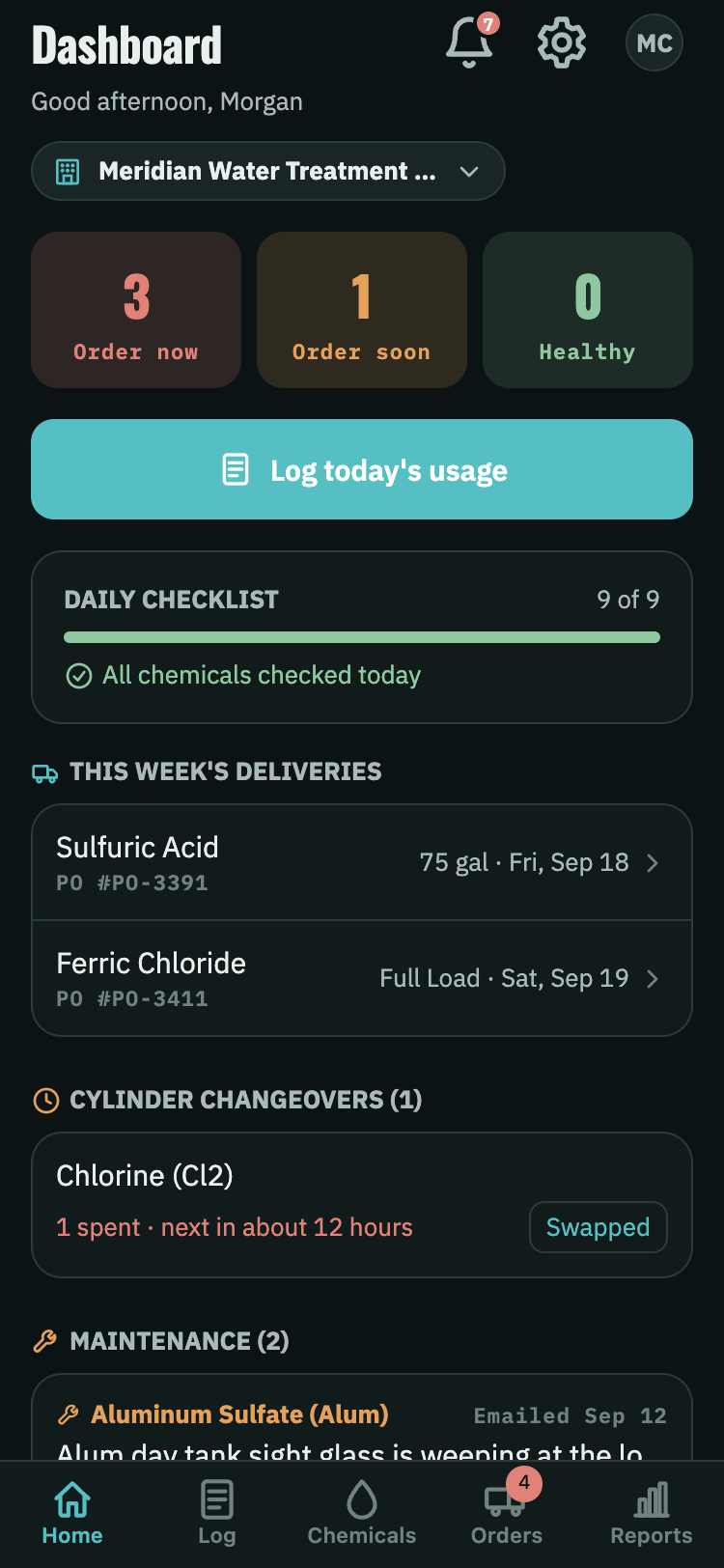
What the dashboard shows
- ORDER NOW / ORDER SOON / HEALTHY
- Every chemical at this site, counted by how urgent it is. Tapping one filters the list below.
- DAILY CHECKLIST
- How many chemicals have been logged today, out of how many are set up. This is the round, and it is the one thing to finish each day.
- THIS WEEK’S DELIVERIES
- Orders you have placed that are due in. A date in red is overdue — the truck has not arrived and nobody has recorded it.
- MAINTENANCE
- Problems somebody flagged during a round. They stay here until marked fixed.
- NEEDS ATTENTION
- Chemicals sorted by urgency, each with days of supply left and how full the tank is.
2. Logging what was used
One tap from the dashboard, or the Log tab. Each chemical is set up to be logged one of two ways, and the screen shows whichever applies — you are never asked to choose.
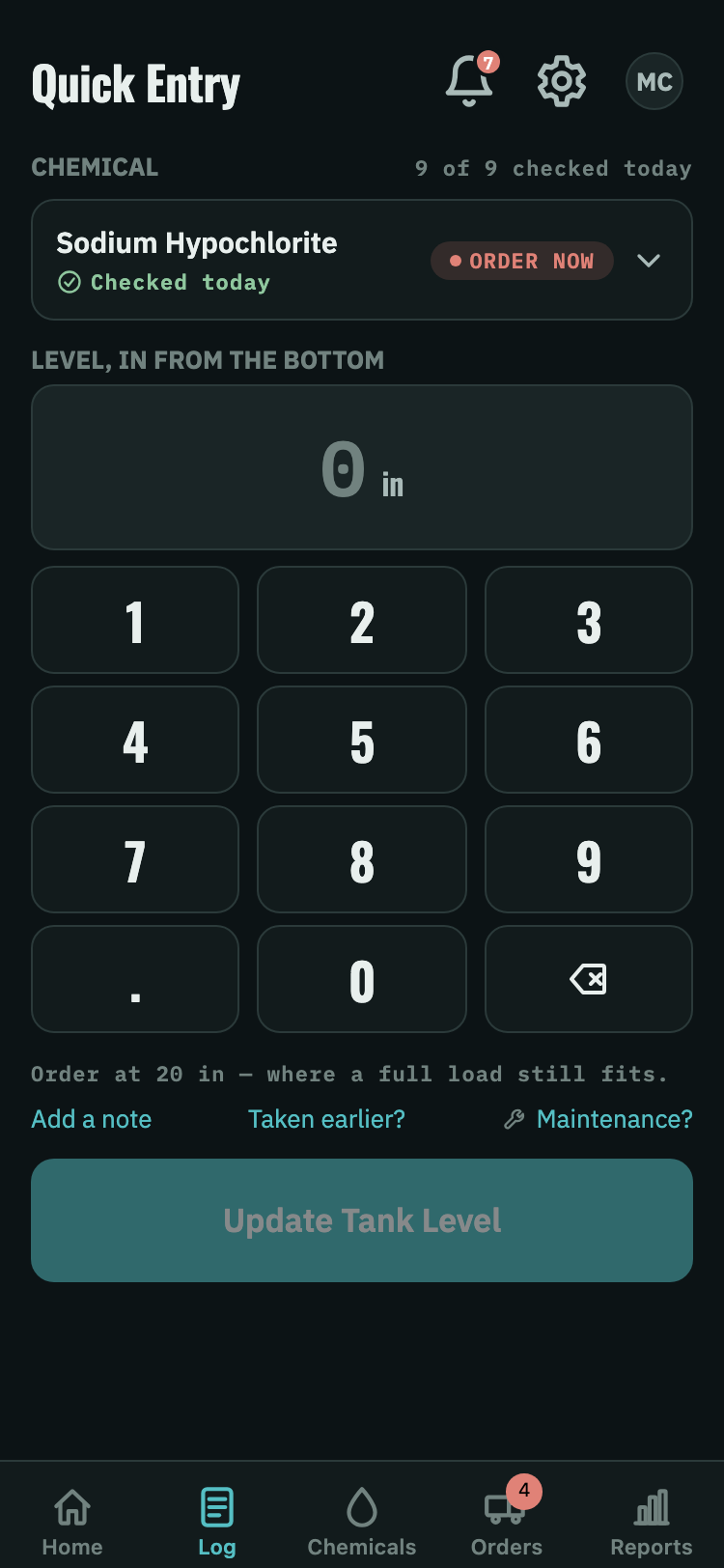
Tank level, or amount used
Tank level is a reading off the gauge — inches, feet, or gallons, whichever that tank is gauged in. ChemLevel works out how much was used from the change since the last reading.
Amount used is the figure straight off a meter or a batch sheet. Use it where there is no usable gauge.
The keypad is deliberately large: this gets done in gloves, at a tank, in poor light. The line underneath tells you the level at which this chemical needs reordering, so you know as you type whether you have just crossed it.
- Add a note records why a day was unusual — a pump calibration, a line flush. It shows on the entry afterwards.
- Taken earlier backdates the entry if you are catching up on yesterday.
- Logging again on the same day corrects the day rather than adding to it.
- A past entry can be corrected: open it from Recent Entries on the chemical. The value, the note and the time it was taken are all editable, and every change is kept in the change history with who made it.
3. Cylinders
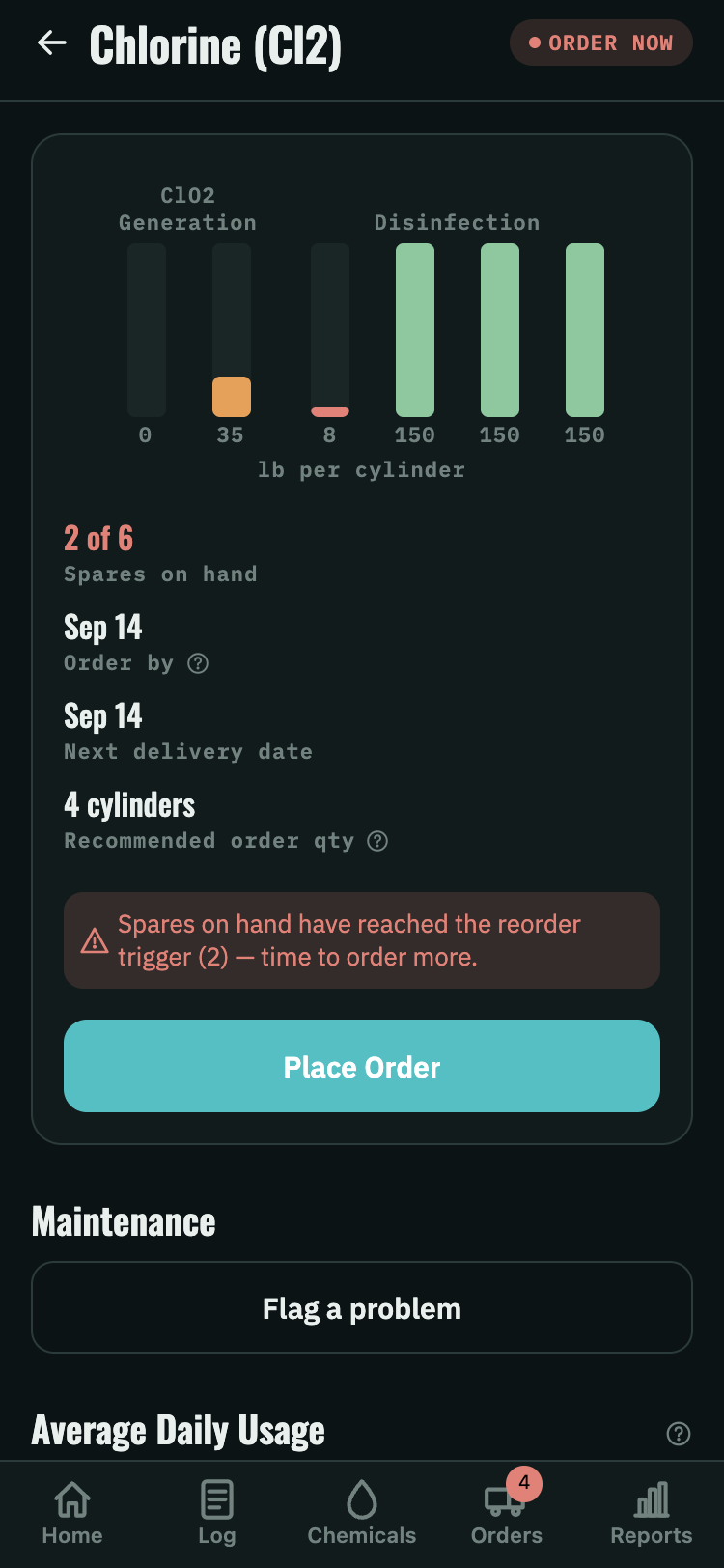
Weighed, not gauged
A cylinder rack is not a tank, so it does not pretend to be one. You weigh each cylinder in service and enter the weights; ChemLevel tracks how much gas is left across the rack and how many full spares are on the floor.
Ordering works off the spares count rather than a percentage: you set the number of full spares at which it is time to reorder — usually one, so the plant is never down to none.
If one rack feeds more than one use — straight chlorination and a chlorine dioxide generator, say — you can name each purpose and say which positions belong to it. It does not change the ordering math; the rack is still one shared pool.
Changeovers are counted in hours once they are close. A day count reading “0” cannot answer the question actually being asked at the rack — before I go home, or does the next shift get it — so under a day it reads swap in about seven hours instead, and names the cylinder or the purpose it feeds where that can be said without guessing. It stays a day count where the rack has not been weighed lately, because an hour figure from a two-day-old weigh-in would be more precise than the reading behind it.
Anything due inside the window you choose is listed on the Dashboard, and stays there until the rack is weighed — like everything else on that screen, it states what is true rather than what you have acknowledged. The bell and push are told once, only when a rack is genuinely down to hours, and clearing that is the same gesture as clearing any other alert. Each row carries a Weigh in button straight to the entry screen.
4. Reading one chemical
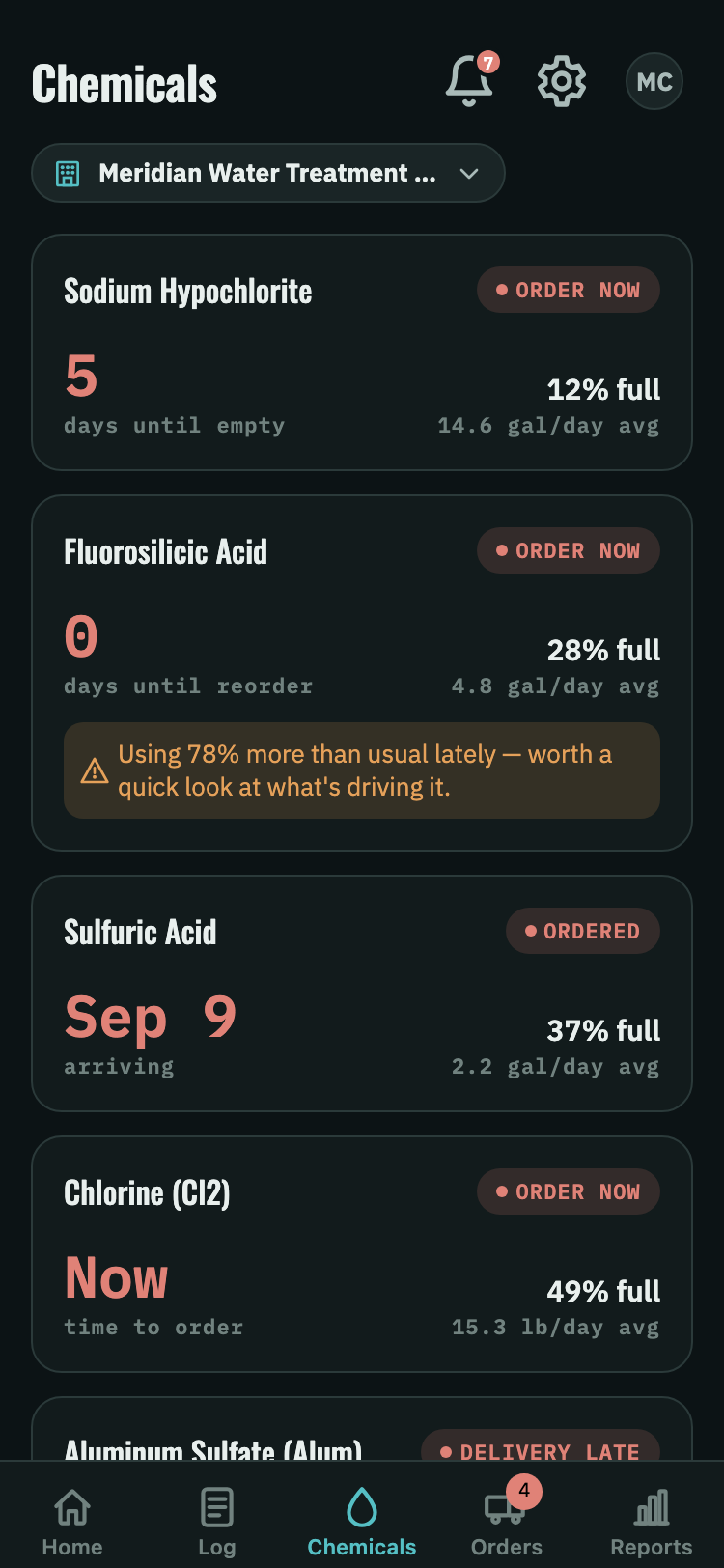
Finding it
The Chemicals tab is every chemical on this site, worst first, each with how long it will last and how full it is. Tap one for the detail below. The dashboard shows the same chemicals filtered to the ones needing attention.
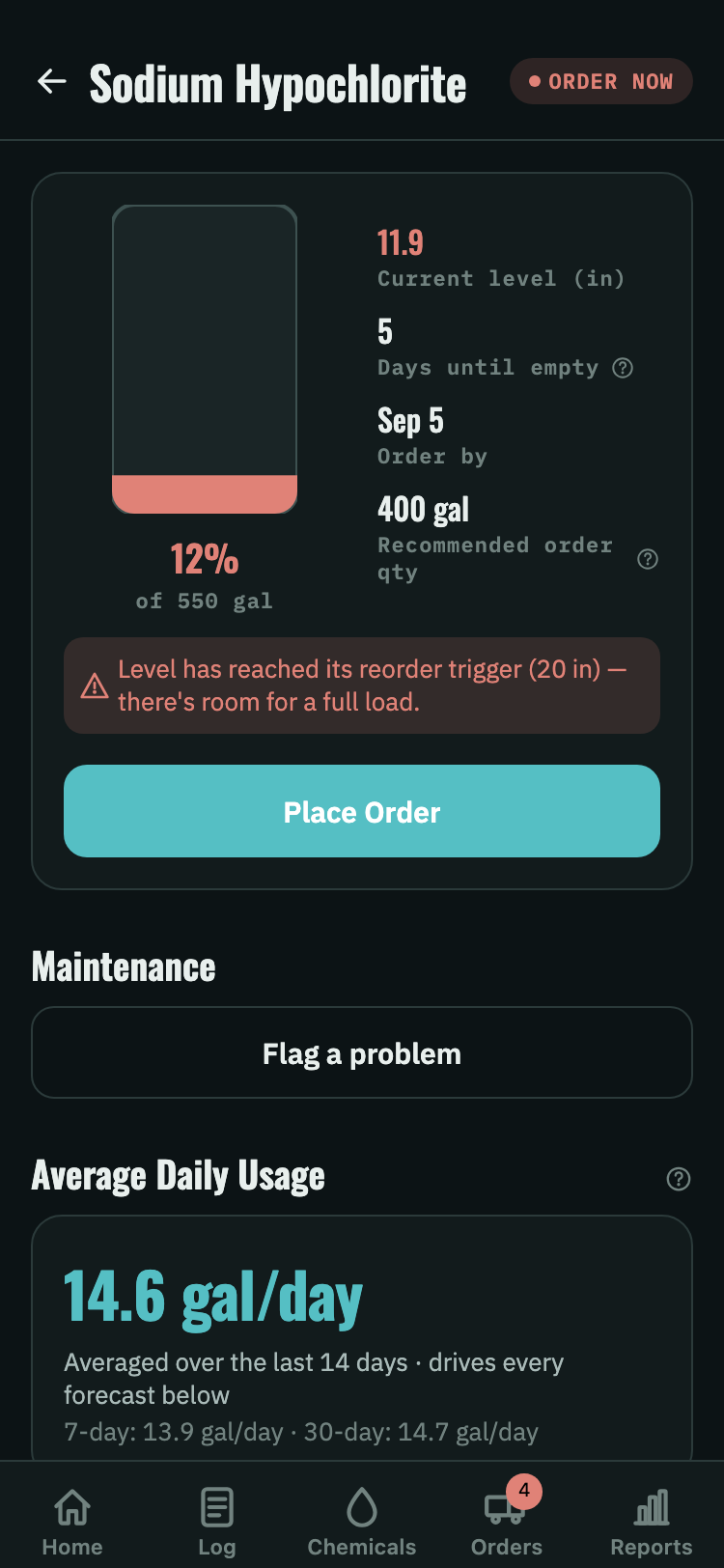
The figures at the top
- CURRENT LEVEL
- The last reading, in the unit that tank is gauged in.
- DAYS UNTIL EMPTY
- What is left, divided by the average daily usage below. It is a runway, not a promise — it moves as usage does.
- ORDER BY
- The last day you can order and still have it arrive before the tank reaches its reorder level, using this chemical’s supplier lead time. Once you have placed that order this becomes NEXT ORDER BY and moves on a cycle, beside a DELIVERY DUE date for the load already coming — a deadline you have met is not one worth repeating back at you.
- RECOMMENDED ORDER QTY
- What to ask for. Either the standard load you have configured, or enough to fill, capped so a delivery cannot overflow the tank.
- AVERAGE DAILY USAGE
- A 14-day average, shown with the 7-day and 30-day figures beside it so you can see whether the plant is trending. This is the number every forecast on the page is built from.
Several of these carry a small ?. Tapping it opens How the numbers work at the entry for that figure — what it is worked out from, and the arithmetic done in real numbers. It is the answer to give when somebody asks where a figure came from.
5. What the forecast is telling you
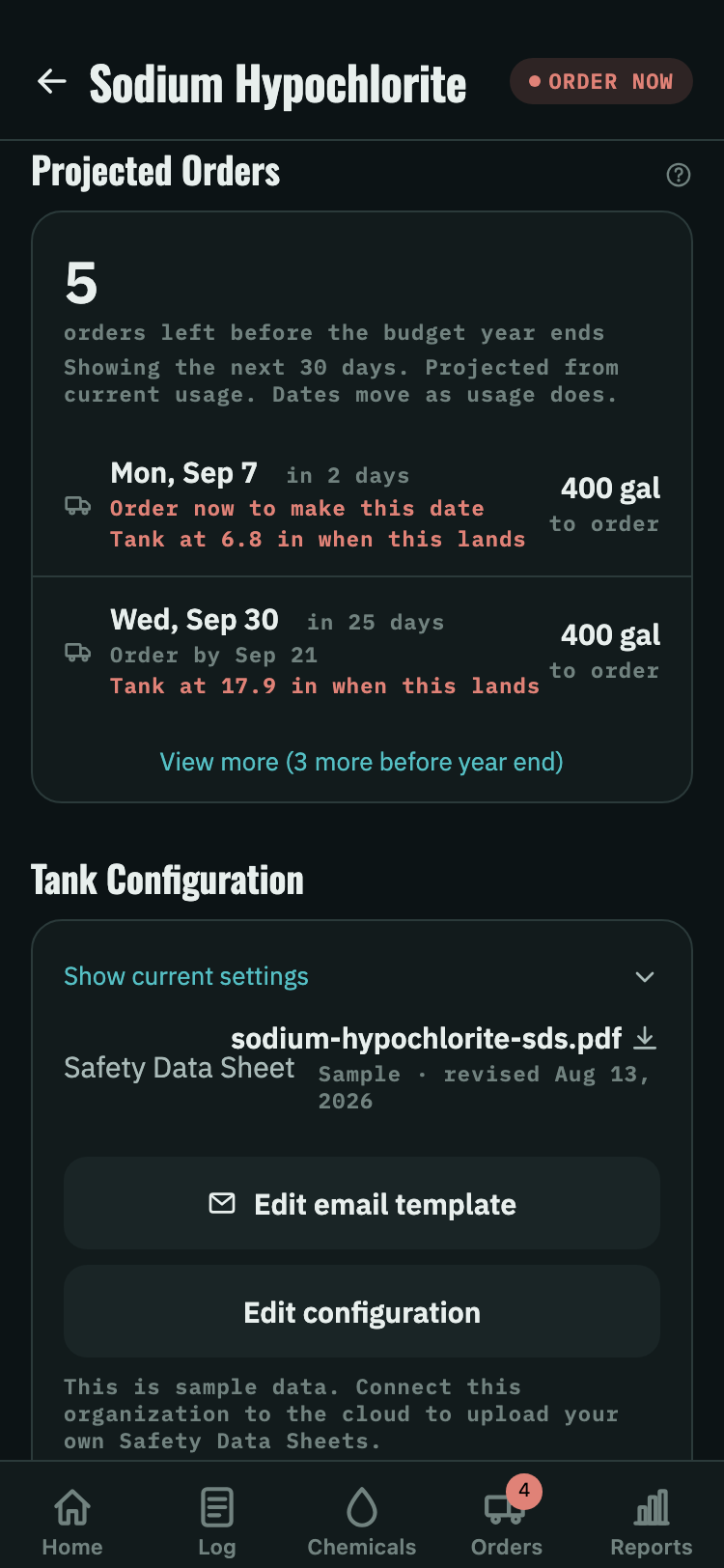
Projected orders
Rather than one reorder date, ChemLevel projects the whole run of orders to the end of your budget year at current usage. That is the list a budget conversation actually needs: how many more times, roughly when, and how much each time.
Each row says the date the delivery should land, the quantity, and what the tank will be down to when it does — which is how you check the plan leaves no gap.
Dates move as usage moves. A hot week pulls them in; a shutdown pushes them out.
Asked where one of these figures comes from? How the numbers work takes every derived number in the app — the usage rate, the runway, the order quantity, the budget projection — and shows what it is worked out from, with the arithmetic done in numbers. The same page is inside the app under Settings, and beside each figure there is a control that opens it at the right entry.
6. Ordering
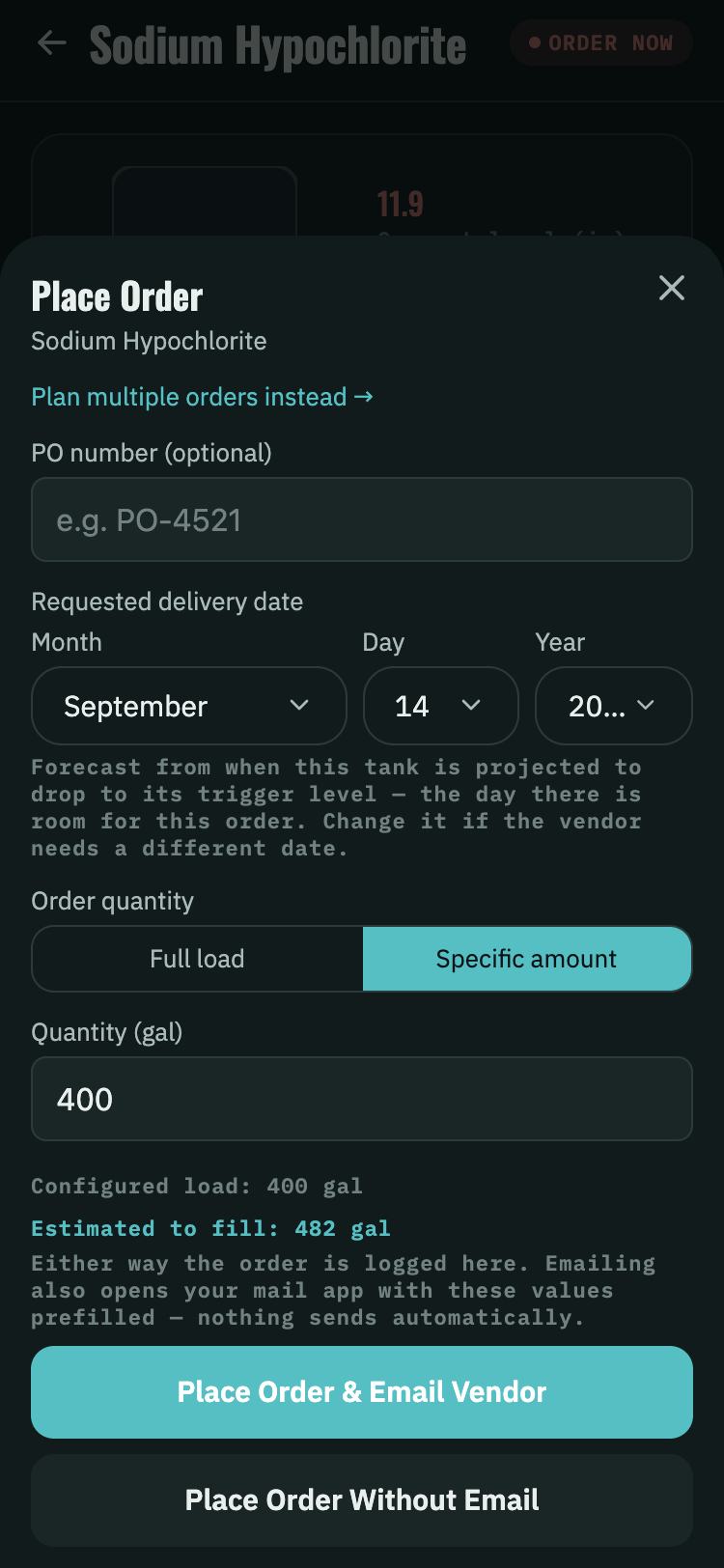
Placing one
The sheet opens with the recommended quantity and a delivery date already worked out from the forecast — the day the tank has room for this order. Change either if the vendor needs something different.
Two ways to finish, and neither sends anything by itself. Place Order & Email Vendor logs the order and opens your own email client with a message prefilled with the quantity, the date, and your site’s delivery details — you read it and you send it, or you do not. Place Order Without Email logs it and stops there, which is the one to use when you order by phone, on a vendor portal, or against a standing contract. Either way the order is recorded, the forecast updates, and the reorder alert quiets.
A chemical with no vendor email on file can still be ordered — you just get the second button on its own.
“Plan multiple orders instead” puts several chemicals on one sheet, for a vendor you buy more than one thing from.
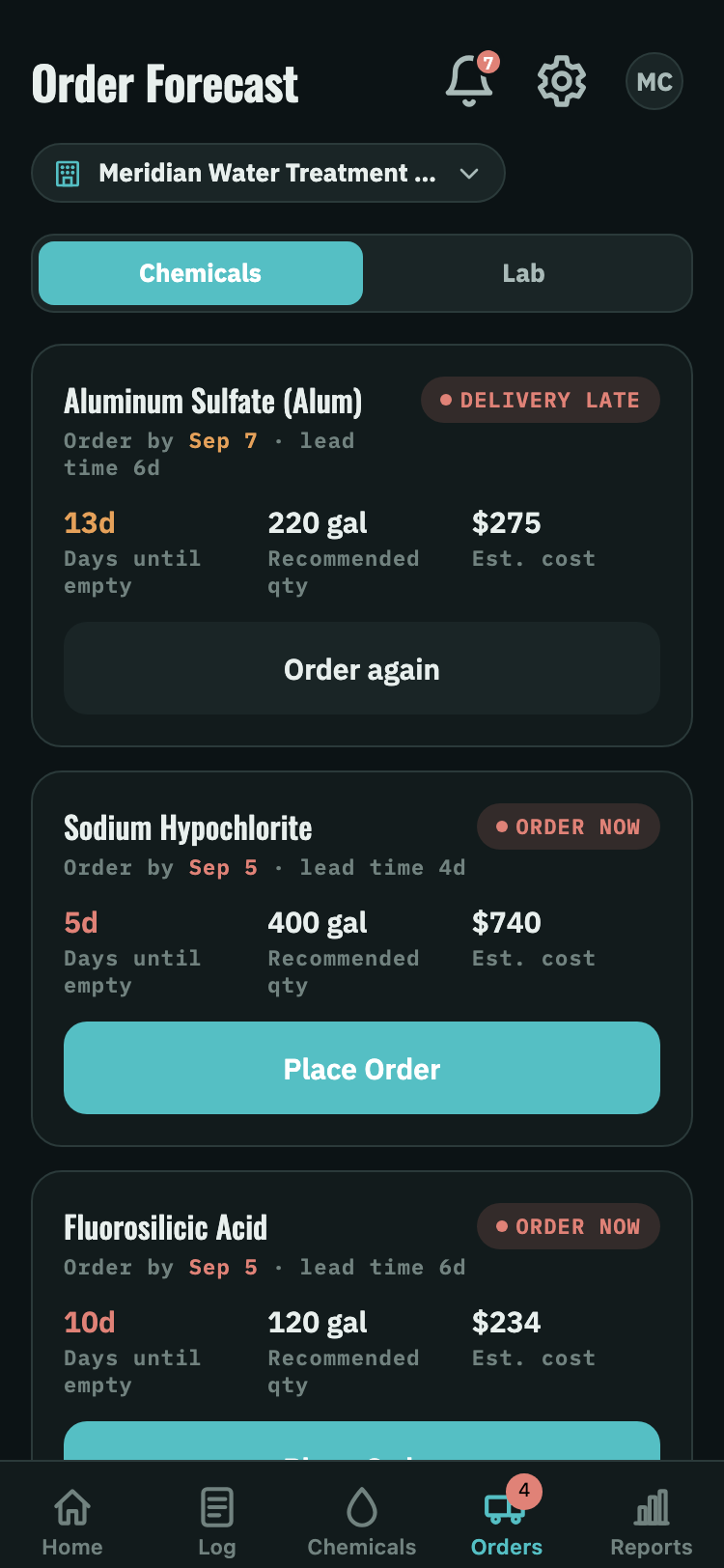
After it is placed
The order sits in Orders until it arrives. When it does, record the delivery — quantity and what it actually cost, which is what makes the spend figures real rather than estimated.
An order that has passed its date without a delivery shows as overdue on the dashboard, which is usually the first anyone hears that a truck did not turn up.
7. Flagging a problem
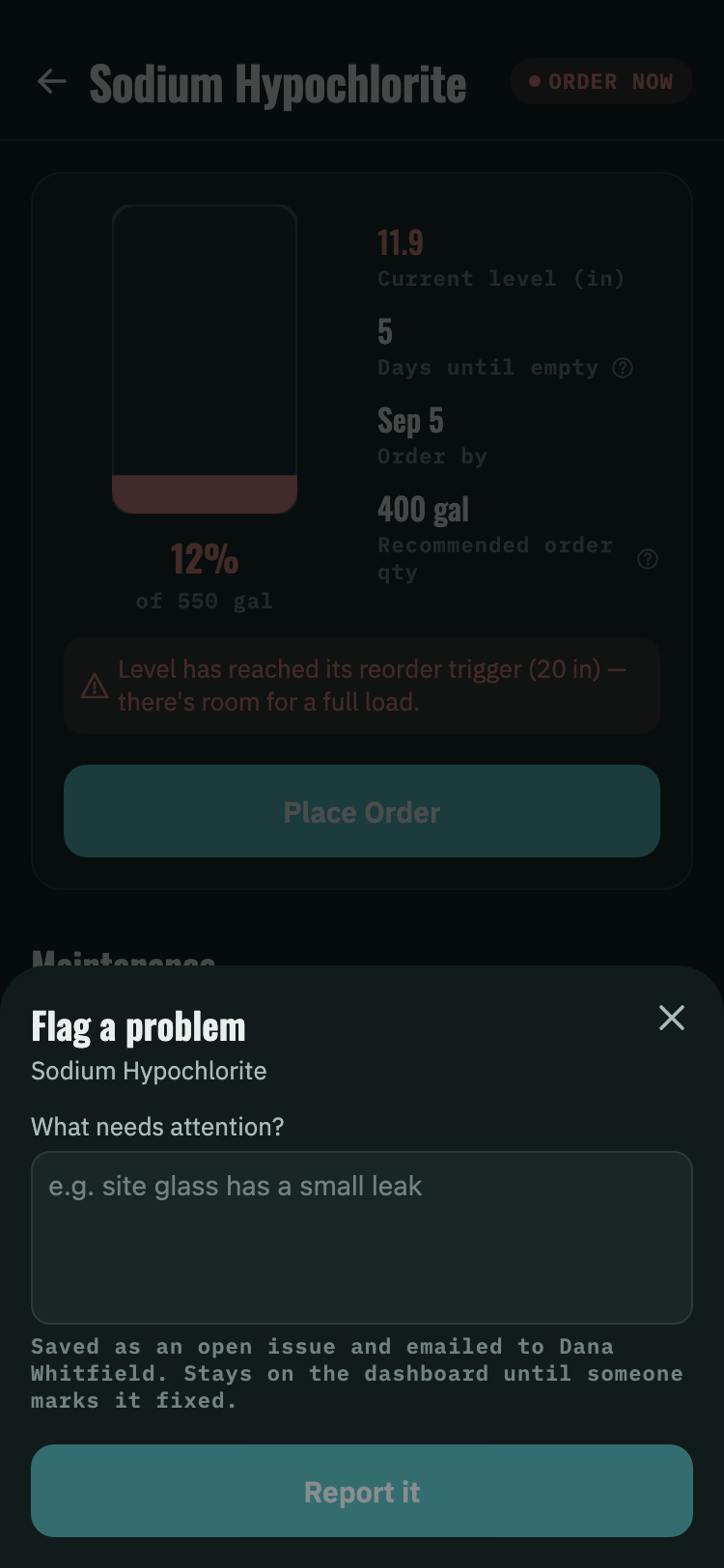
Found on the round, dealt with later
A weeping fitting or a pump losing prime gets flagged from the chemical it belongs to. It is emailed to the site’s maintenance contact and it stays on the dashboard until someone marks it fixed — so it survives the shift change that would otherwise lose it.
Marking it fixed removes it. ChemLevel is not a work-order system and does not keep a list of things already dealt with.
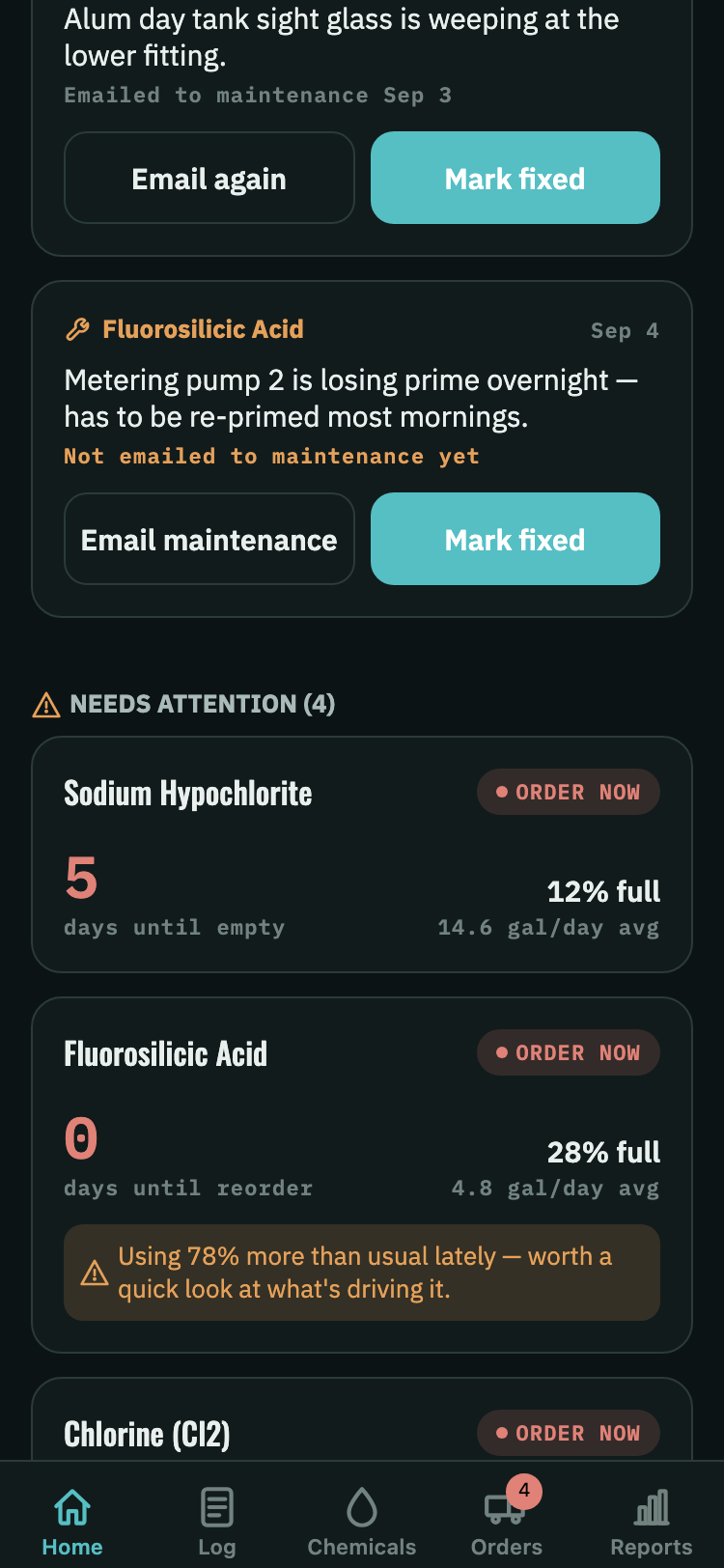
Where they sit until then
Open problems sit on the dashboard, above the chemicals, with what was reported and whether it has been emailed yet. Email again re-sends if the first one went unanswered.
Anyone at the site can flag one. Only supervisors are notified about them, on the grounds that the operator who raised it does not need telling.
8. Reports
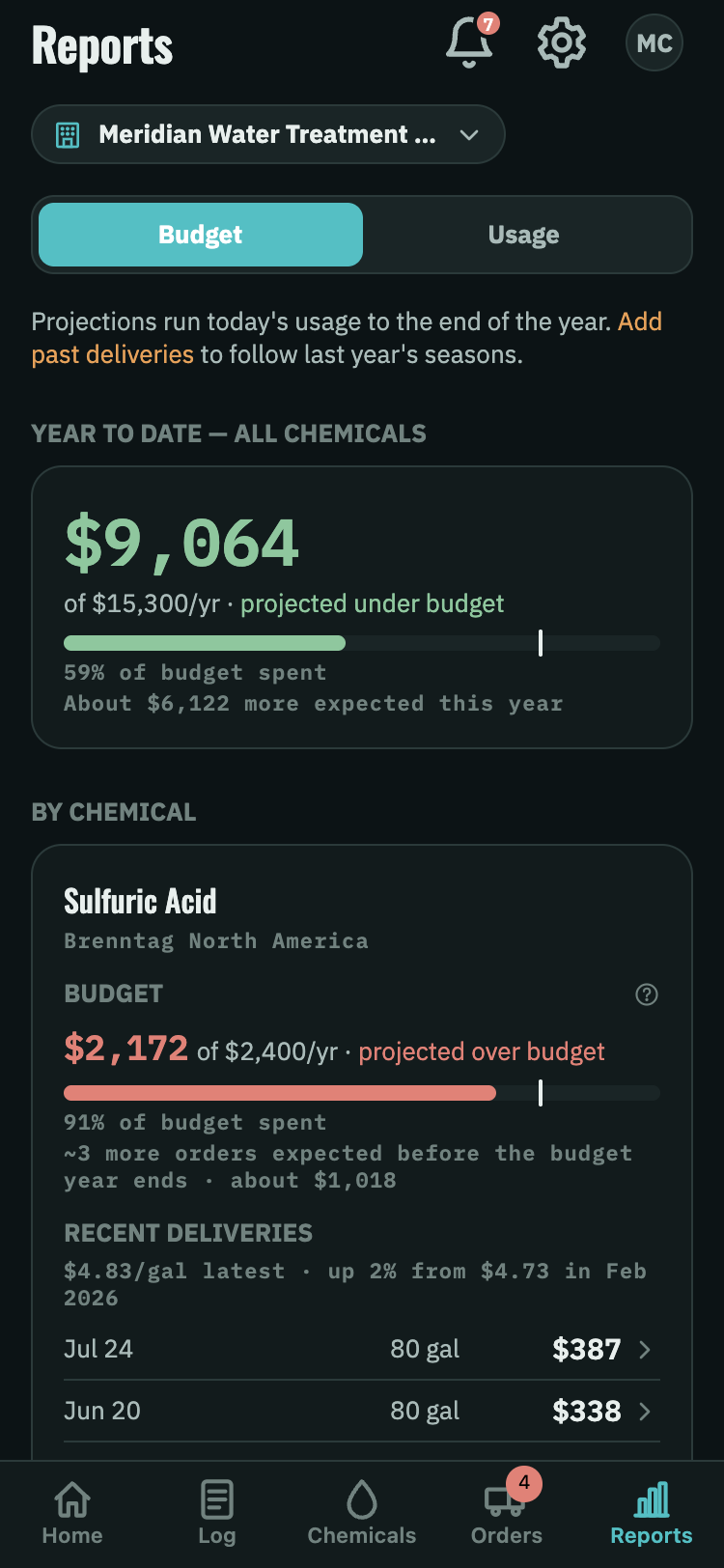
Budget
Spend so far this budget year against what was budgeted, for the site and for each chemical, with a projection of where the year ends at the current rate.
Spend is built from recorded deliveries at what they actually cost, not from estimates. Each chemical also shows its recent delivered price and whether it has moved — the figure to bring to a contract renewal.
Most plants use far less of everything in winter, when they take in less water, so today’s rate run to the end of the year is wrong in both seasons. Give ChemLevel last year’s deliveries and the projection follows last year’s seasons instead: supervisors paste them in under Settings → Budget Year → Past deliveries, straight from a spreadsheet — the date each delivery arrived, the chemical, and how much came. Nothing is saved until you have checked what was read, and past deliveries never count as spend. Deliveries from after ChemLevel started measuring a chemical are left out, because its own readings already cover that time. A chemical following last year’s pattern says so on its card, and when that projection and today’s rate disagree by 10% or more, both are shown. Once ChemLevel has a year of its own readings, it follows last year without them.
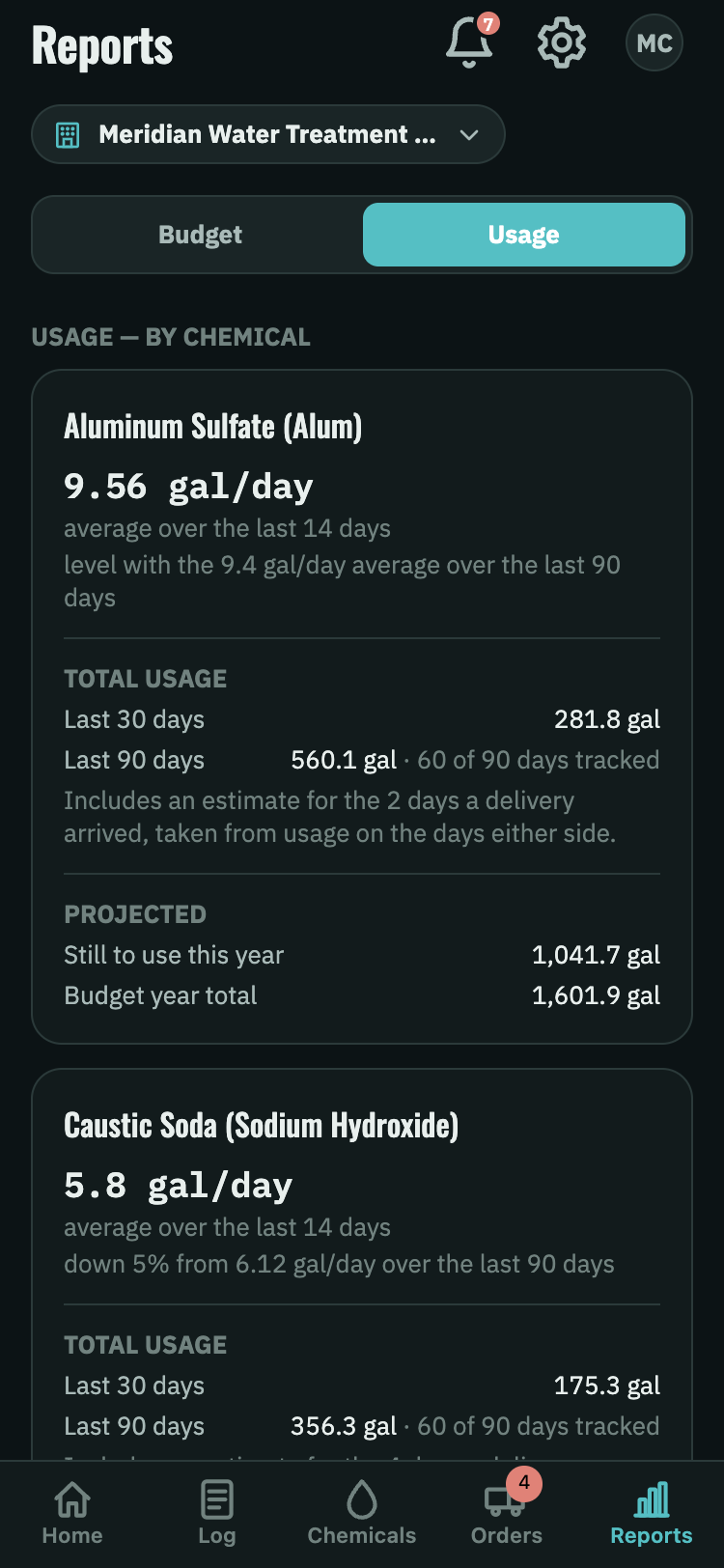
Usage
How much of each chemical the plant has actually gone through, over the windows you care about. This is the view for a monthly report or a regulator’s question, and it exports. On a day a delivery arrives the tank level goes up, so that day’s use cannot be read off the gauge; it is estimated from the days either side, and the card says when a total includes one.
9. The lab
The monthly count
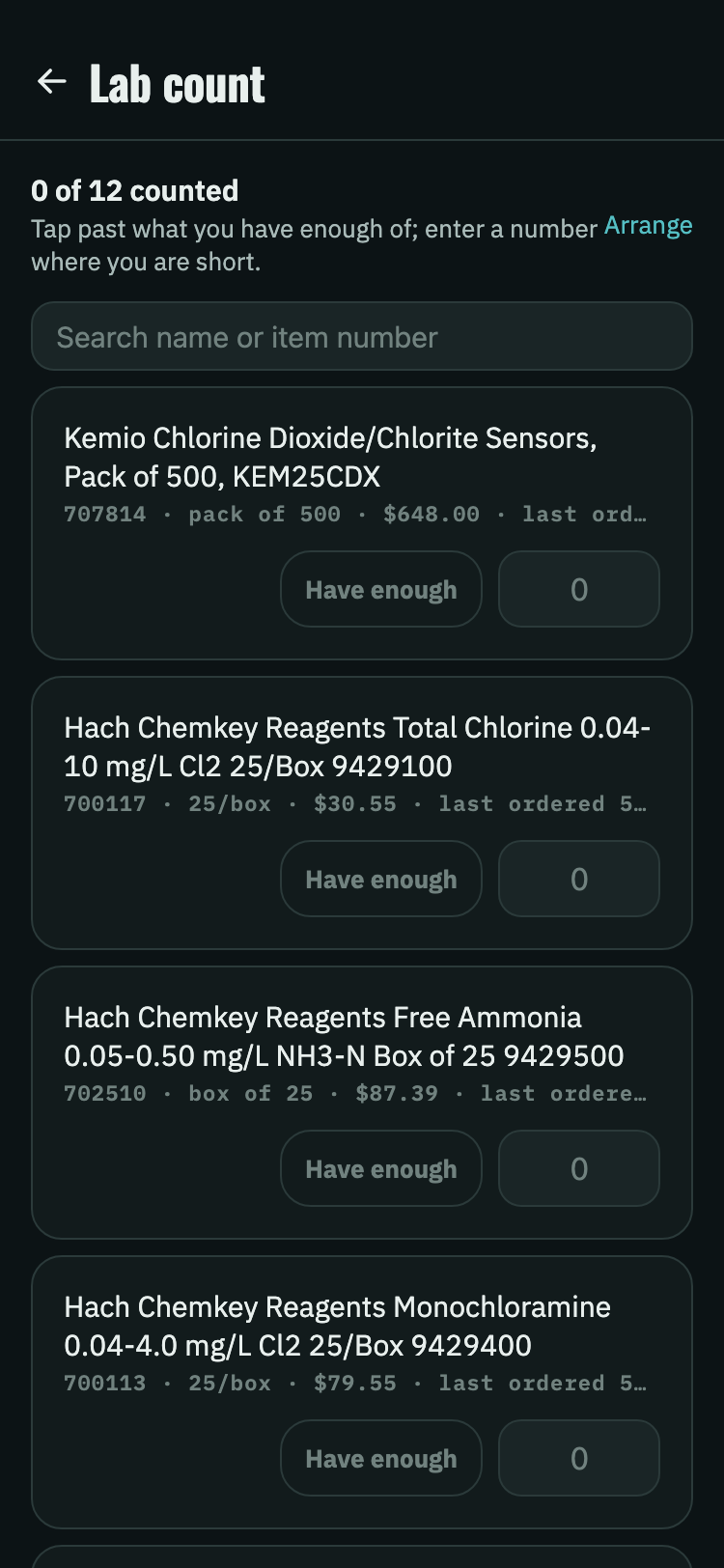
Reagents and standards are not dosed, so they are not forecast — they are counted. The count is built to be walked: tap Have enough past everything you have plenty of, and type a number only where you are short.
The list can be dragged into the order your shelves are actually in, so the walk matches the room. What you type becomes the order list at the end.
Where the list comes from
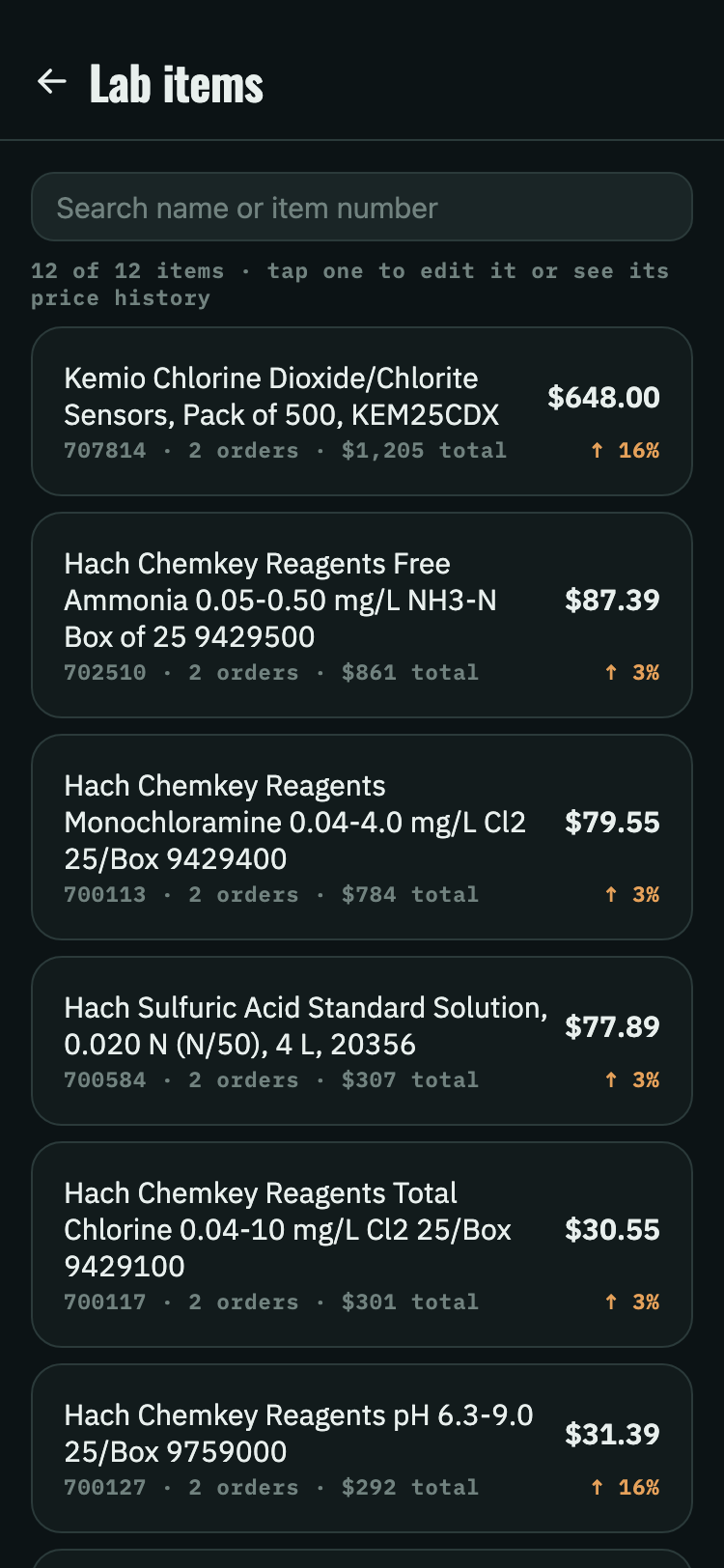
You do not type forty products with catalog numbers. Paste a vendor’s order confirmation, or pick the PDF they sent, and ChemLevel reads the items, quantities and prices off it and builds the list for you.
The confirmation is read on your device and discarded — there is no upload and no stored copy. A purchasing document carries addresses, contact names and account numbers that an inventory system has no use for.
Each item keeps its price history, so you can see what a reagent cost last time and whether it has gone up.
10. Notifications
The bell
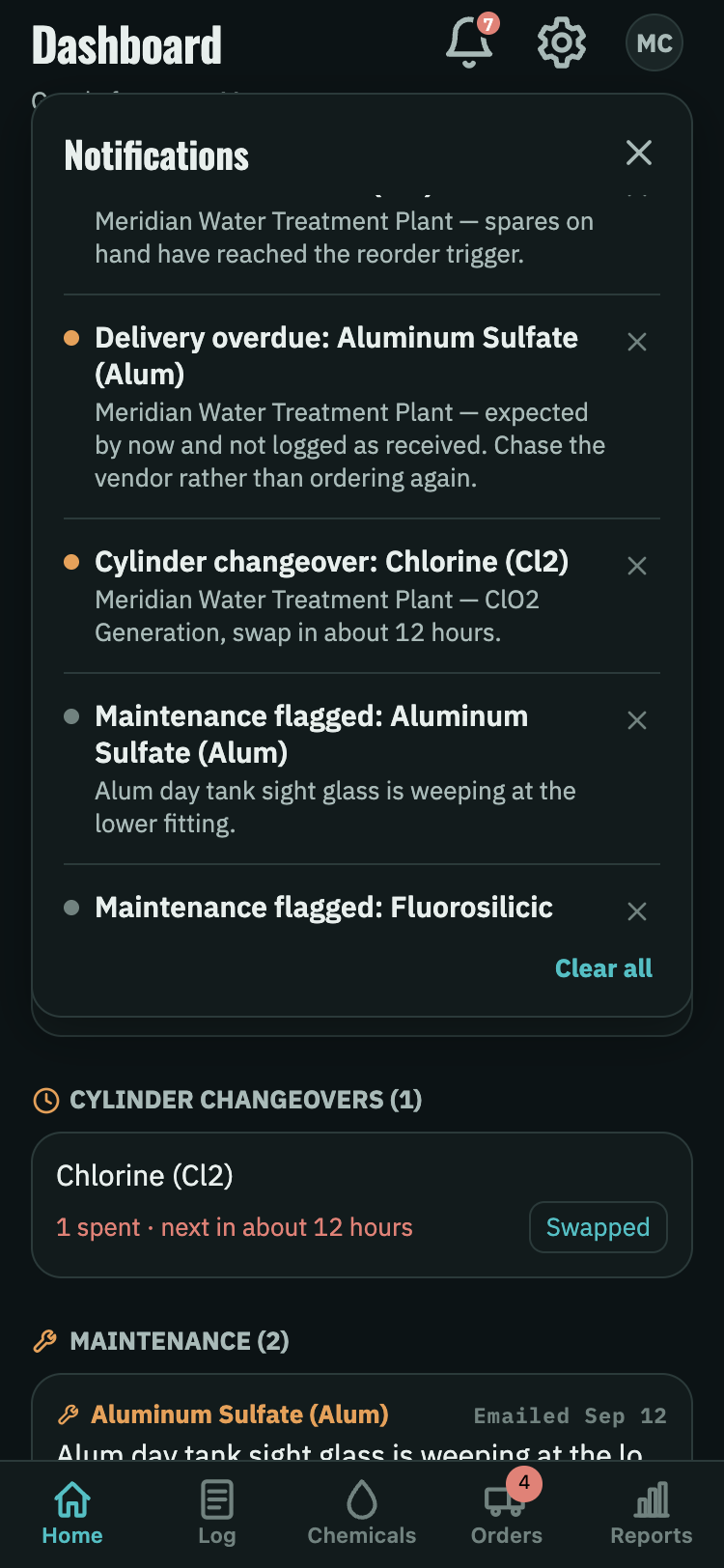
At the top of every screen. It lists what needs attention right now — reorders due, a cylinder rack hours from a changeover, chemicals not checked recently, maintenance flags. Clearing one is an acknowledgment, not a fix: it says you have seen it.
A cleared alert follows you to your other devices, so clearing at the desk means it is gone on the phone too. It comes back on its own if the condition goes away and returns.
Choosing what you are told
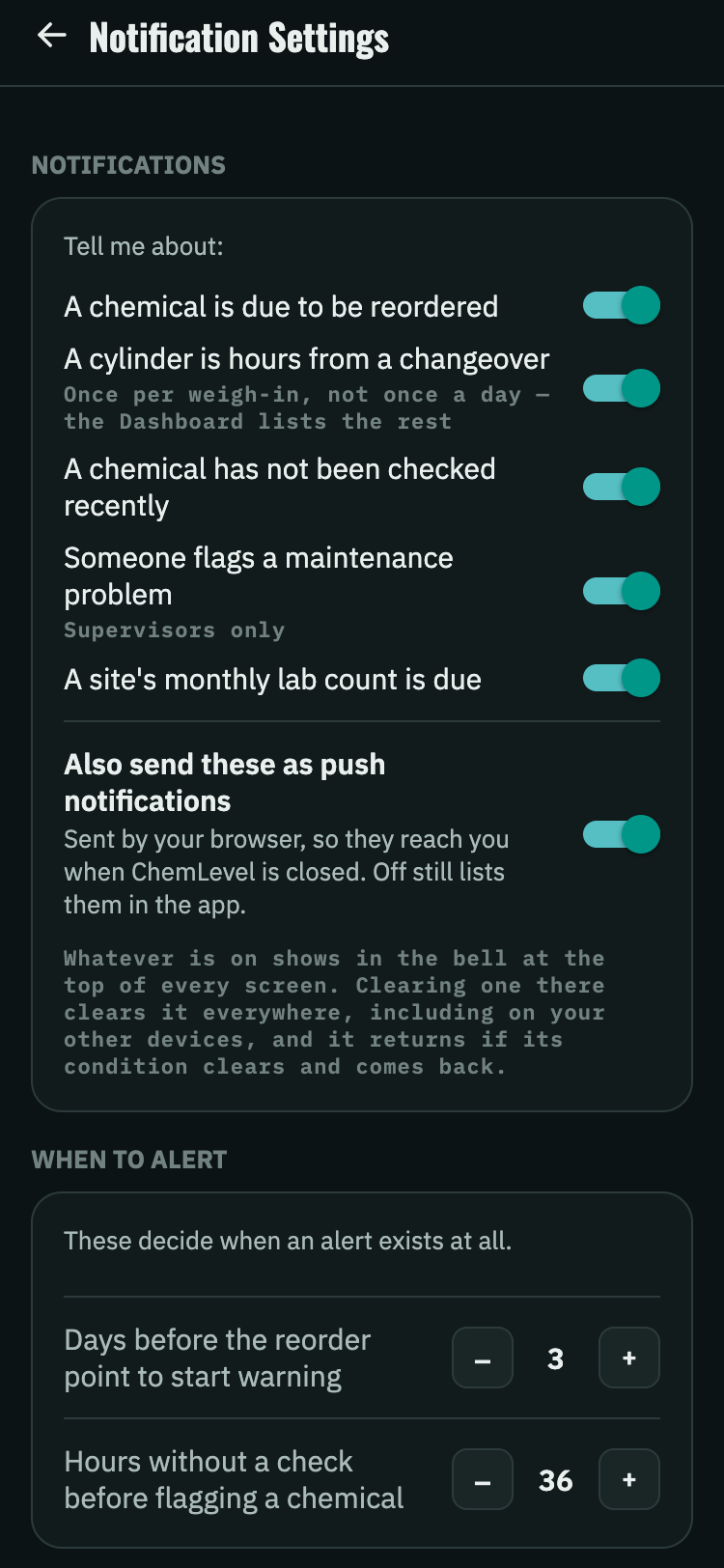
Five kinds of alert, each refusable on its own, and one switch for whether they also reach you as push notifications when the app is closed. The bell and push are the same alerts — there is one answer to what you want to be told about, not two.
The cylinder changeover is the one that behaves differently, and deliberately: a rack with several bottles in service has a changeover due most days, so it is told once, when the rack is down to hours, rather than every day it is coming. The full list stays on the Dashboard, and how far ahead that looks is set under Forecasts.
- DAYS BEFORE THE REORDER POINT
- How much warning you want before a chemical is due. Higher means earlier and more often.
- HOURS WITHOUT A CHECK
- How long a chemical can go unlogged before ChemLevel says so. Set it to match your rounds.
11. Setup and settings
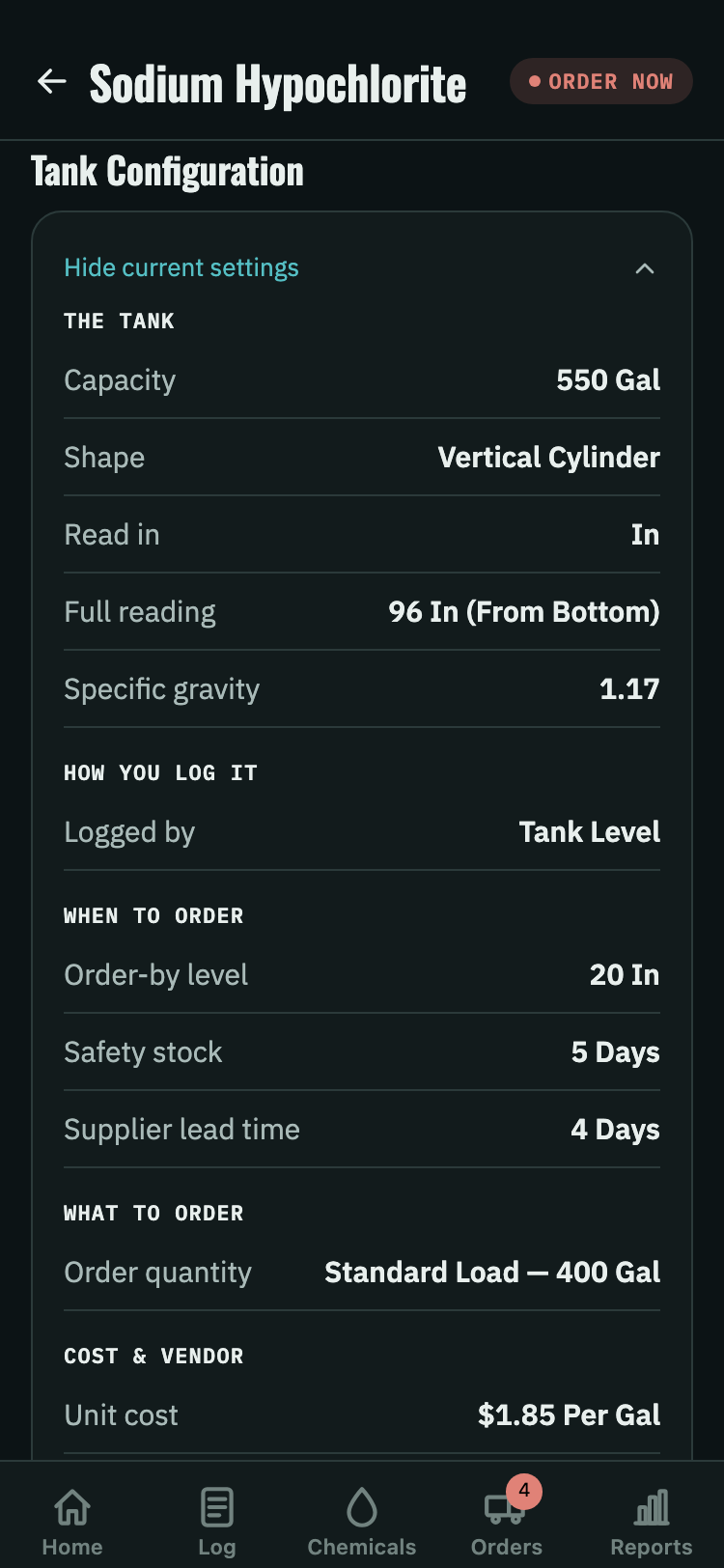
What a chemical needs set up
Set once, changed rarely. Open any chemical and tap Show current settings to see all of it at a glance, or Edit configuration to change one group at a time.
- THE TANK
- Capacity, shape, and how it is read on site — inches from the bottom, gallons, whatever the gauge shows. The shape is what makes a level convert to a volume correctly.
- WHEN TO ORDER
- The level that triggers a reorder, how many days of safety stock you want, and the supplier’s lead time. Those three decide every order-by date.
- WHAT TO ORDER
- A standard load, a top-off, or a full load — whichever matches how you actually buy it.
- COST & VENDOR
- Unit cost and who you buy from. The vendor email is where an order request goes when you choose to email one; leave it blank if you order another way.
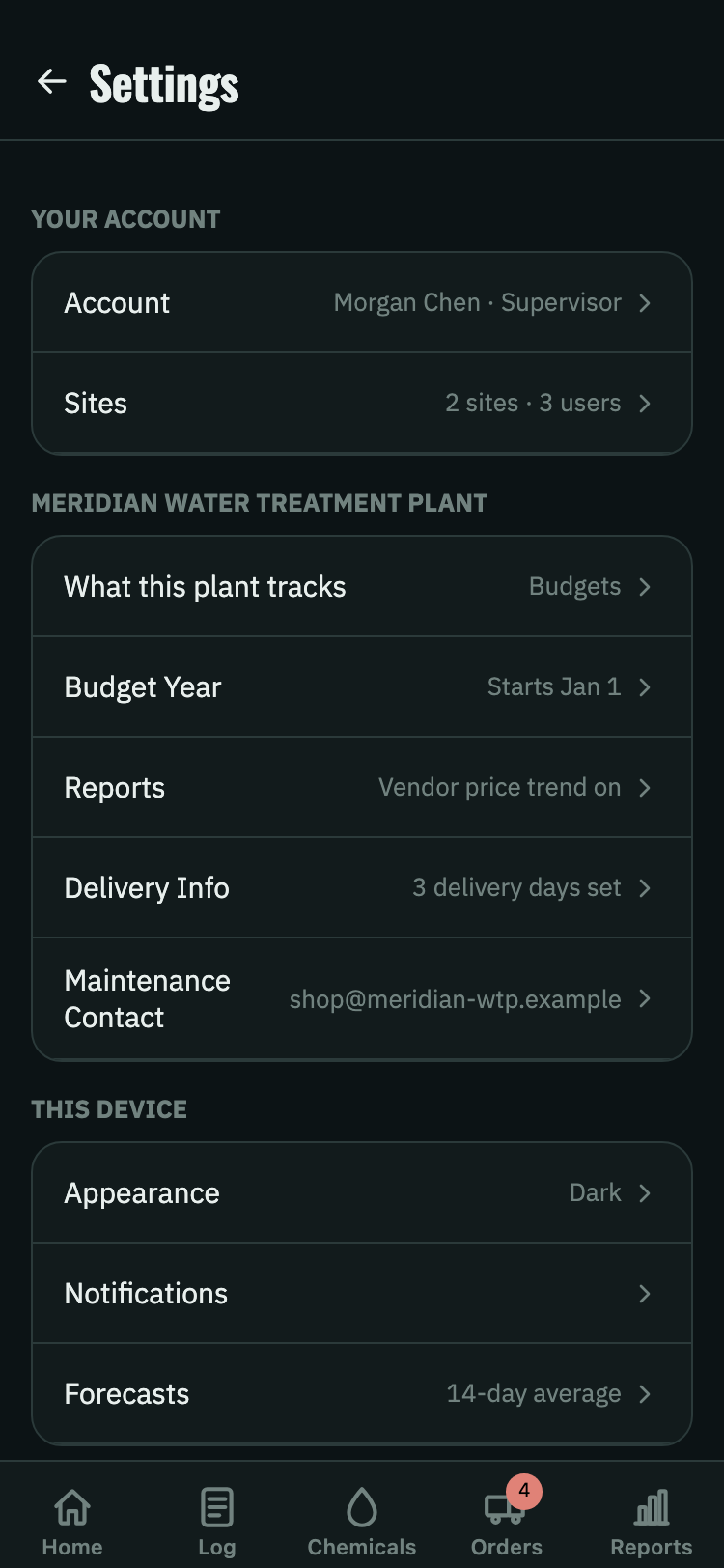
Settings
Grouped by what a setting belongs to: your account, this plant, this device, and your data. A plant setting reaches everyone at that site; a device setting is yours alone.
Plant settings worth getting right early: the budget year, the maintenance contact, and delivery info — the days and hours a truck can actually get in, which ChemLevel uses to keep proposed delivery dates on days somebody is there to take them.
Under Data & support is How the numbers work: every figure the app derives and what it is derived from, quoting the values this plant is actually using rather than the defaults. The same thing is on the website if you would rather send someone a link than a screenshot.
A plant that goes out of service is archived rather than deleted — Settings → Sites, administrators only. Its readings, deliveries, orders and history are all kept, and it can be restored later. What changes is that it leaves the site switcher and stops appearing in Reports, in alerts, and in data exports — so export first if you want its records to hand. Archiving also frees the plant against your plan’s limit, so a replacement set up before your next renewal needs no extra plant on the plan. On Team, which is priced per plant, the next renewal bills only the plants still in service — so restoring an archived plant after that needs room on your plan, and the Sites screen offers Restore only when there is. The last plant still in service cannot be archived: an organization with none has nothing to run, and ending the organization is Close this account below.
At the bottom, Leaving ChemLevel holds the two ways out, kept apart because they are not the same thing. Leave this organization takes you off the roster and leaves the plant’s records alone — the one an operator moving on wants. Close this account ends the organization and deletes everything it holds 30 days later; administrators only. Neither is Remove this account from this device, higher up, which only signs this phone out. What deletion covers is set out in the privacy policy.
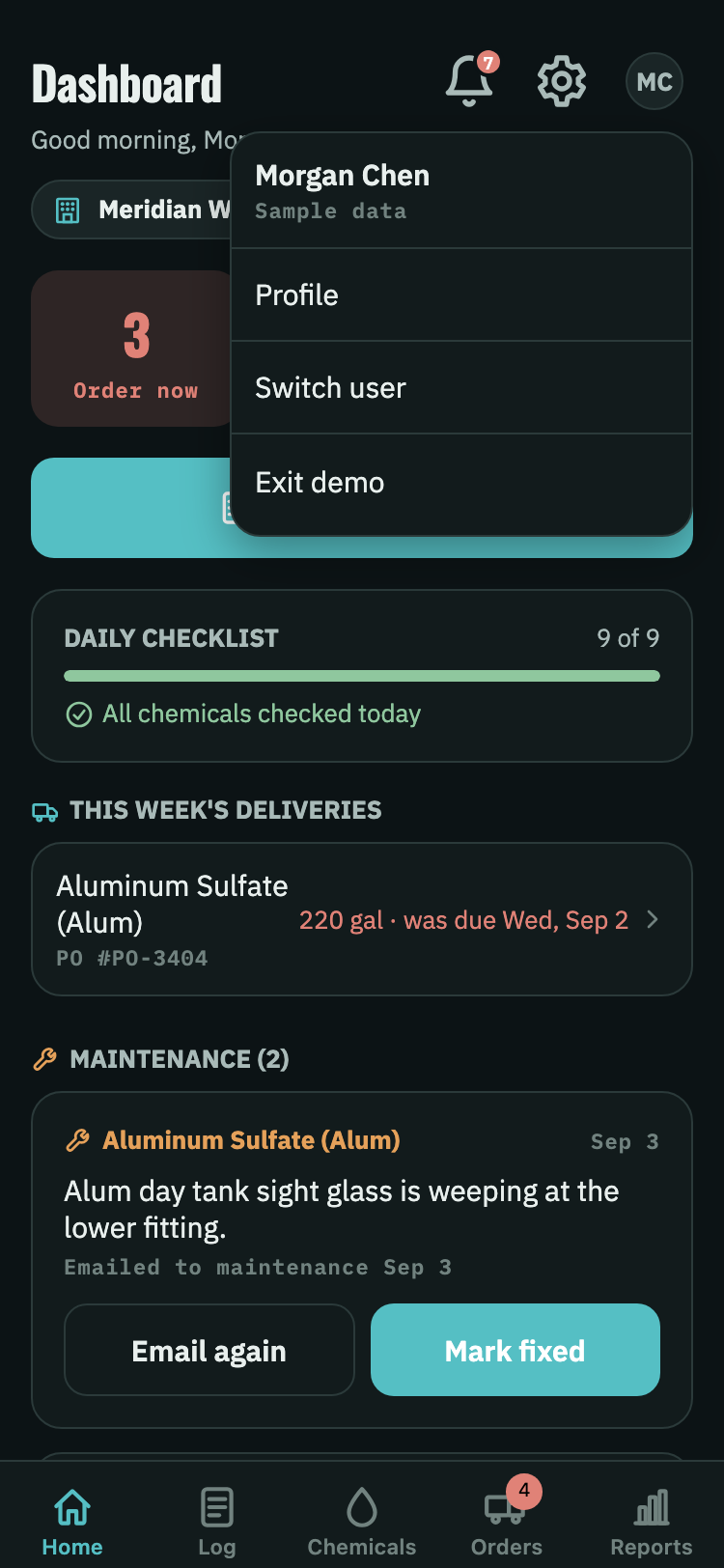
Who is signed in
Top right on every screen. Switch user hands the device to the next operator without signing the account out, which is what a shared plant tablet needs. Supervisors see budgets, reports and team settings; operators see the round.
Try it before you set anything up. The demo at app.chemlevel.com is the whole app on sample data for a fictional two-site operator — every screen above, nothing to install, nothing sent anywhere. When you are ready for your own plant, Settings → Sample data has Create an organization right there — no need to leave the demo first — and your 15-day trial starts from that point.