When to order treatment chemicals
Order too late and the plant runs into the chemical it kept for emergencies. Order too early and the truck arrives at a tank with no room for the load. Here is how to work out a reorder point from the supplier’s lead time and a safety stock, how much safety stock your own records call for, how room in the tank and delivery days move the date, and when to change the numbers. Every figure and source on this page was checked on October 19, 2026.
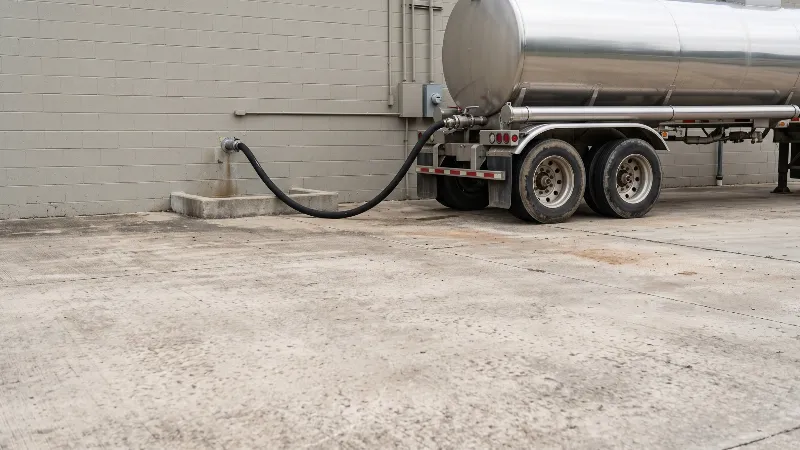
Order when what is left will last until the truck arrives, with a margin for a truck that is late and a week that runs heavy, and plan the truck for a day the tank has room for the load. The rest of this page is the detail behind each of those, for liquid chemicals delivered in bulk. Chlorine cylinders have a section of their own.
It is a summary for plant staff, not a purchasing policy. Your utility’s procedures, your supply contracts and your state’s rules come first. If something here is wrong or out of date, tell us and we will check it.
1. The short answer
- Reorder point
- The supplier’s lead time plus your safety stock, in days of use. Order when the tank is down to that many days.
- Lead time
- From when the order can go out to when the chemical can be fed, in calendar days. Use the longest you have seen lately, not the quote.
- Safety stock
- Enough for a late truck and a heavy week together: the highest use × the longest lead time, less the average use × the average lead time.
- Room for the load
- A load can land once the tank is down to its full reading less the load, and no sooner.
- In a shortage
- Order earlier, and tell the supplier how many days of storage you have. EPA’s example is ordering at half full rather than a quarter.
2. The reorder point
The order has to go out while what is in the tank can still carry the plant until the truck comes, with something left over. Put in days of use:
A hypochlorite tank
A plant uses 120 gal of sodium hypochlorite a day. Its supplier delivers 5 days after an order, and the plant keeps 4 days of safety stock.
The days are calendar days. The tank draws down on weekends and holidays whether or not anyone orders or delivers on them.
Keeping the reorder point in days, rather than as a mark on the gauge, lets it follow the plant’s use: the same 9 days is more gallons in a heavy month and fewer in a light one. A level written on the gauge stays put while the use moves (section 7). Tank level to gallons turns gallons into the inches a sight glass reads.
3. What counts as lead time
Lead time is everything between the moment the order could go out and the moment the chemical is in the tank and can be fed. The supplier’s quote is only part of it:
- Getting the order out. A purchase order to raise, a signature to wait for, a vendor that takes orders only until noon.
- The supplier’s days, counted as calendar days. Three business days from a Thursday order is the next Tuesday: five days of use.
- Days no truck comes. Weekends, holidays, and the days of the week a supplier does not run your route (section 6).
- Anything before the load can be used. If a delivery waits on a sample or a certificate before it goes into the tank, that wait is lead time too.
The best figure is your own: when each order went out and when its truck came. Use the longest of the last several rather than the usual one, or the reorder point will be right on the weeks that go well.
EPA’s guide to supply chain resilience asks utilities to keep talking to suppliers about lead times, so the expected delivery is realistic, and notes that buying from a supplier further away may mean ordering ahead to allow for a longer one. EPA’s report on chemical supply chains adds that a distributor generally delivers within about a five-hour drive, so that a driver can get there and back inside the limit on hours driven. A backup supplier beyond that distance is likely to need more notice.
Sources: EPA, Supply Chain Resilience: Guide for Water and Wastewater Utilities (EPA 810-F-22-007, 2022; PDF), pages 4 and 5; EPA, Understanding Water Treatment Chemical Supply Chains and the Risk of Disruptions (EPA 817-R-22-004, 2022; PDF), section 5.2.
4. How much safety stock
Safety stock is the chemical you plan never to use: what is still in the tank when the truck comes on an ordinary week. It is there for the weeks that are not ordinary, and there are two kinds. The truck can be later than the lead time, and the plant can use more than the rate the reorder point was worked out at. A common rule of thumb in inventory planning covers both from your own records:
The same tank, from its records
Over the last year the tank averaged 120 gal a day, and its heaviest week averaged 160. Trucks came 5 days after the order on average, and 8 days after at the longest.
It assumes the heaviest week and the slowest truck arrive together, so it errs high. A plant that has never seen both at once may settle lower, and a year of records that missed a summer will come out too low.
Where a state sets the floor
Most state storage rules size the tank, not the stock, but two say how much has to be on hand. Louisiana requires at least 10 days of chemical supply on site at all times, at maximum average day demand, and Nevada a 30-day supply, unless the state allows less. There, the safety stock cannot be less than the rule’s days, counted the rule’s way. The storage rules by state quote both.
And not too much
Every day of safety stock is chemical that sits. Sodium hypochlorite loses strength as it does, and the Ten States wastewater standards keep a hypochlorite container to about a month’s needs for that reason (quoted here). EPA lists the chemical’s shelf life, worker and community safety, and the thresholds of the regulations on hazardous chemicals as things to weigh before storing more.
Source: EPA’s supply chain resilience guide, page 8.
5. Room for the load
A bulk delivery has to fit. A tank cannot take a 4,000 gal load until it is down to its full reading less 4,000 gal, so a delivery has a window: it opens on the first day the tank has room for the load, and closes on the last day before the plant would be into its safety stock.
The same tank, taking 4,000 gal loads
The tank from section 2 holds 6,000 gal at its full reading. It uses 120 gal a day and keeps 4 days, 480 gal, of safety stock.
The truck can be aimed at either end of the window:
- The end. Order at the reorder point, 1,080 gal, and the truck lands with the safety stock still in the tank. The least chemical sits on site, and the load fits with 1,520 gal of space to spare.
- The start. Aim the delivery at the day the tank first has room, and order the reorder point ahead of that day, asking for that date: at 2,000 + 9 × 120, or 3,080 gal. The truck lands with 2,000 gal, nearly 17 days of use, and could come 12 days late before the safety stock is touched. The price is more chemical on hand: across a delivery cycle the tank averages 2,000 + 4,000 ÷ 2, or 4,000 gal, against 480 + 4,000 ÷ 2, or 2,480, at the other end.
Aiming at the start, leave a little room below the line. A slow week leaves more in the tank than planned, and a truck that arrives at a tank still above 2,000 gal goes away with chemical on it.
When the window closes
The same tank, offered 5,600 gal loads.
This is why several states ask for a tank that holds one and a half times a delivery (quoted here). Sized that way, 6,000 gal for a 4,000 gal load, a third of the tank is left for the window and the safety stock.
The same arithmetic sizes the order. What fits is what the tank holds at its full reading, less what will be in it on the morning the truck comes: 4,000 gal for a truck landing at 2,000, and 5,520 for one landing at 480.
6. Delivery days
Most suppliers deliver on weekdays, some only on set days of a route, and a plant may receive only when staff are there to meet the truck. The delivery date has to be one of those days, and it moves a different way at each end of the window:
- At the end, earlier. The truck is wanted on the last delivery day before the safety stock would be touched. Later means using it.
- At the start, later. The truck is wanted on the first delivery day once there is room. Earlier means the load does not fit.
A weekend at each end
A plant takes deliveries Monday to Friday.
A holiday is a day no truck comes, so the same rule applies. Ask suppliers for their holiday schedules before the end of the year, when several fall close together.
7. When to change the numbers
- The use changes with the season. A reorder point in days follows the use; one marked on the gauge does not. The tank’s 1,080 gal is 9 days at 120 gal a day and under 7 at 160. Look at a level-based reorder point again before the heavy months.
- The supplier changes. A new supplier, depot or route means a new lead time. Read it from the first few orders rather than the quote.
- A shortage is coming. EPA’s guide says to assess the inventory, contact the supplier, and tell them the plant’s current days of storage and what losing or reducing service would mean. Then expect to be flexible: “ordering early or at a lower trigger point (e.g., ½-full rather than ¼-full),” taking deliveries outside normal hours, or smaller orders more often. A shortage that affects, or could affect, your system can be reported to EPA at SupplyChainSupport@epa.gov.
Some chemicals are likelier to be short than others. EPA’s 2022 assessment of 46 chemicals the water sector depends on rated none at high risk of a supply disruption and six at moderate-high, the highest tier any reached: chlorine, sodium hypochlorite, sodium hydroxide (caustic soda), phosphoric acid, disodium phosphate and DADMAC. EPA’s guide recommends identifying backup suppliers that do not depend on the same manufacturers as the primary one. For those six, a backup supplier and a safety stock set from the worst delay you have seen are worth the most.
Sources: EPA’s supply chain resilience guide, pages 3, 5 and 12; EPA’s supply chain risk report, sections 3.3.1 and 4.3.
8. Keeping track of it
ChemLevel works out each chemical’s order-by date from its readings, and moves it as the use moves. On a chemical’s Ordering view:
- Safety stock and Supplier lead time, in days. Together they make the reorder point.
- Order-by level, optional, in what your gauge reads. With one set, the delivery is aimed at the first day the tank is down to it, and the order goes out the reorder point before, so set it where there is room for a load. A Delivery cushion aims that much lower, so a slow week does not leave the tank too full when the truck arrives. With no order-by level, the delivery is aimed to land with the safety stock still in the tank.
- Order quantity: a standard load, a top-off, or the vendor’s full load. A standard load is cut to the room the tank is expected to have on the day it lands.
The days deliveries are taken go under Settings → Delivery info, and every delivery date moves onto one of them. A chemical’s card turns amber once its order-by date is no more than half the reorder point away, and red when it is today. Level by day shows what the gauge should read each morning for the next 90 days as the orders land, which is the window from section 5 on paper. An order already placed that looks like more than the tank will have room for raises Delivery may not fit, and a rate well above or below the usual is flagged as unusual usage: a cue to look at these numbers again.
The guide shows the ordering screens, How the numbers work gives the exact rules for each date, and the demo (opens in a new tab) has a plant to try them on.