Never run out.
Never overstock.
ChemLevel is chemical inventory software for water and wastewater treatment plants. It tracks tank and cylinder levels across every site, forecasts when you'll run out, and drafts the vendor order before you do — for teams stocking sodium hypochlorite, alum, caustic soda, and everything else a treatment plant burns through.
Free for 15 days. No credit card, no sales call — or try the demo first, no signup at all.
- Web Available now
- iOS In development
- iPadOS In development
- Android In development
Six things, done properly
No black-box calculators, no guesswork — just the arithmetic that actually determines whether a plant runs out or overstocks, and the records you need when somebody asks why.
Tank & cylinder inventory
Bulk tanks with real geometry — vertical, horizontal, rectangular — plus discrete 150 lb and 2,000 lb cylinders, tracked side by side in the same system.
Forecasting that accounts for you
Two readings 33 hours apart aren’t two “daily” checks. ChemLevel weights consumption by the actual time between readings, not the calendar.
Orders drafted, not just flagged
When a chemical crosses its reorder point, ChemLevel proposes a quantity, a vendor and a delivery window. Send it as an email from your own mail app, addressed to your vendor, or simply log it if you order by phone or on a standing contract — nothing sends by itself.
Budget you can see coming
Annual caps per chemical, deliveries logged by weight and cost, and a pace-vs-budget number compared against where the year actually is — plus every order still to come before it ends, following last year’s seasons once it has them.
Maintenance where it belongs
A sticking valve or a failing pump gets flagged from the chemical it feeds, not a separate ticket system. Open problems stay on that chemical’s screen until somebody closes them.
The paperwork, on the phone
The current Safety Data Sheet attached to each chemical, reachable on-site in the moment it matters — and a record of who changed what, and when.
Not a mockup. The actual app.
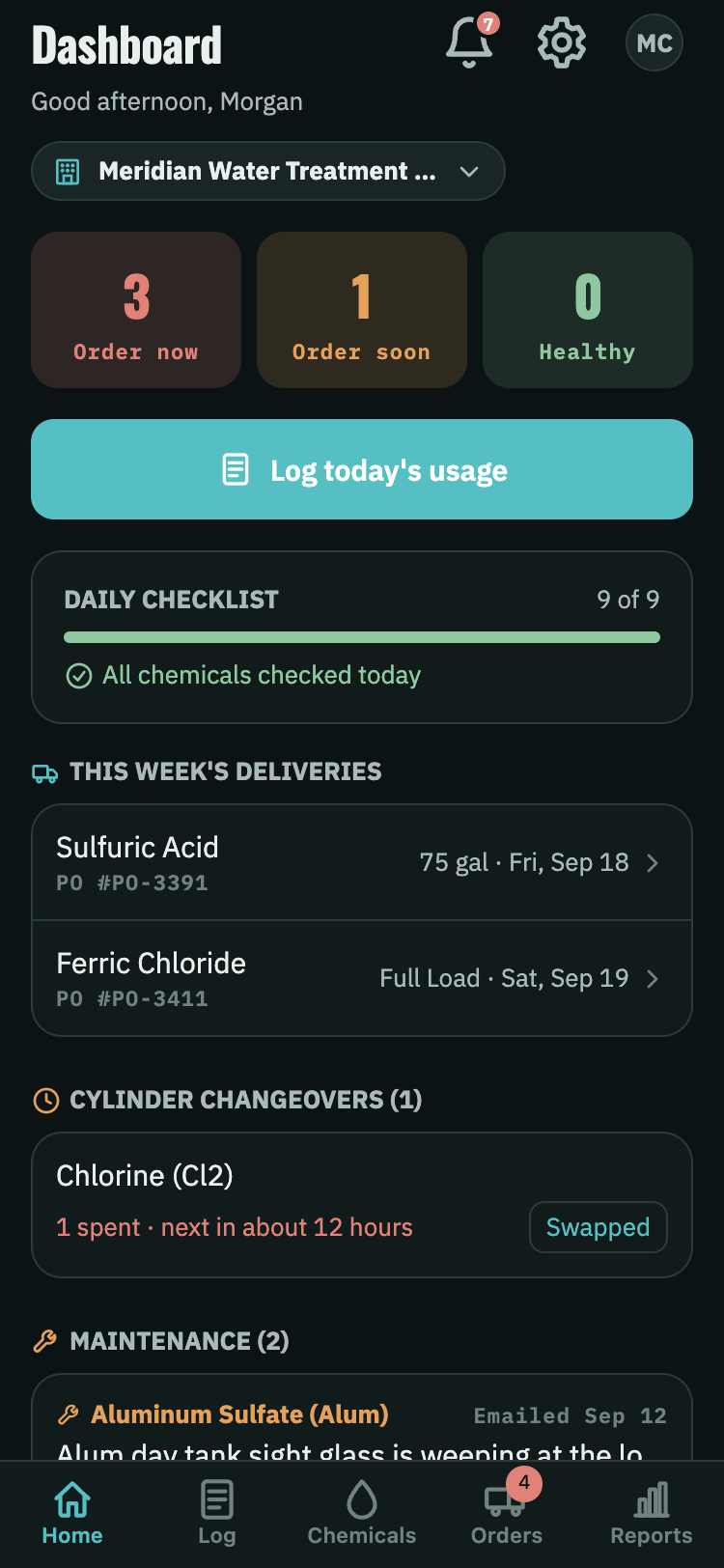
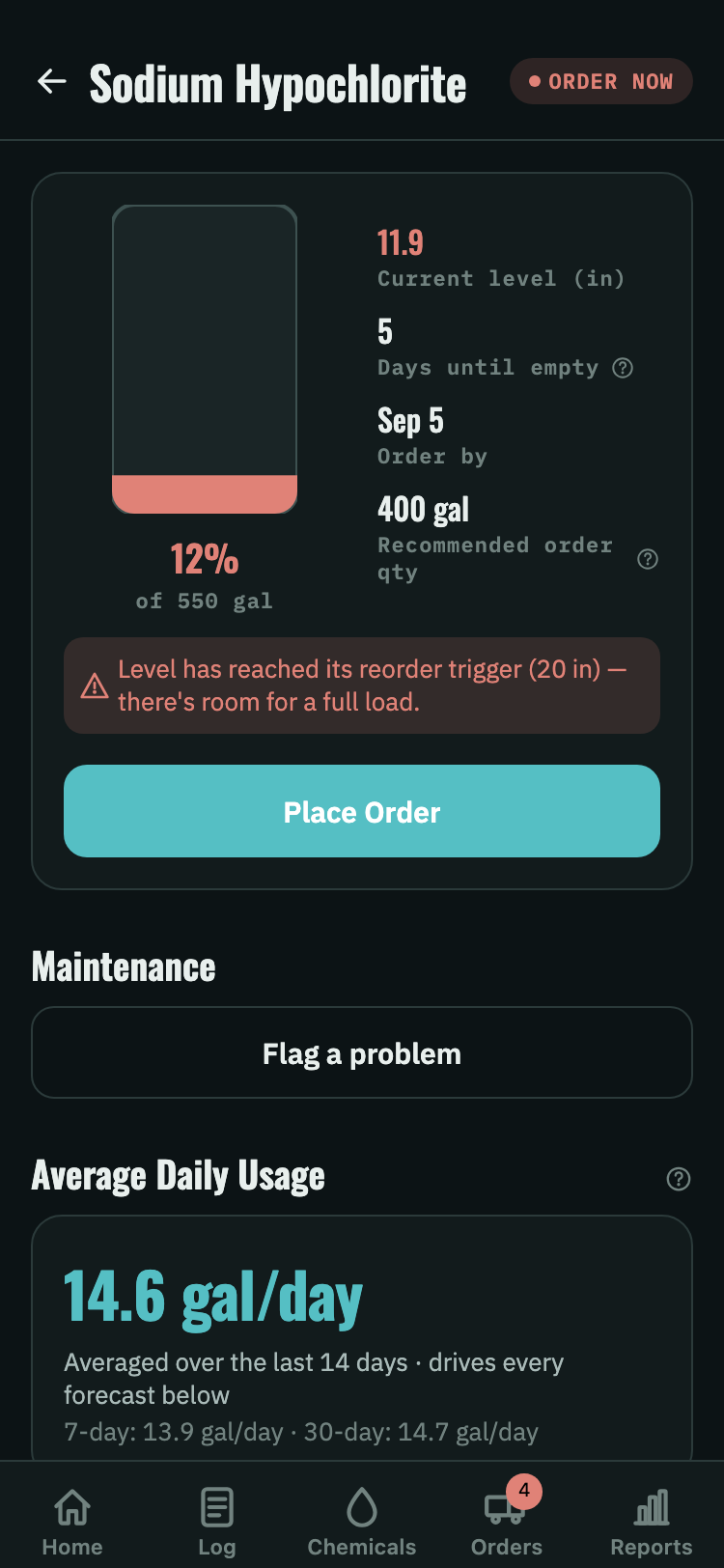
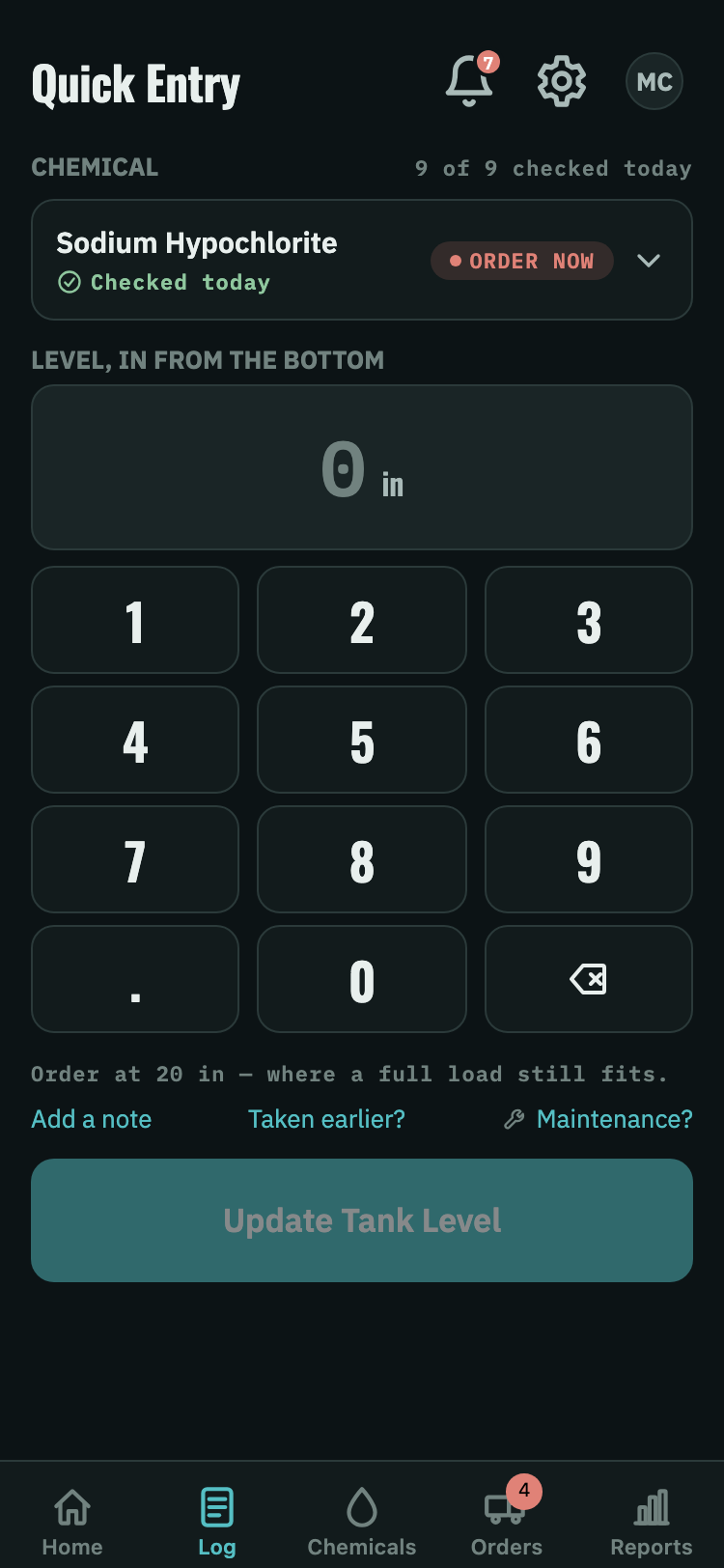
Three screens, one shift — check what needs attention, log a reading, watch the forecast update.
Built for the floor,
not just the office
A reading gets logged in ten seconds, standing next to the tank, gloves on.
One account, every plant
A utility running three plants is not three customers with three logins. It is one account, with people who each see the plants they actually work at.
More than one plant, and budget tracking, are on the Team plan. Roles, permissions and change history are on both.
The lab has a budget too
Reagents, standards and glassware are tracked apart from treatment chemicals — a different budget, a different list, and nobody pretending a box of Chemkeys is a tank.
Three steps, on a loop
Log a reading
Percent, dip, volume, or cylinder weight — whichever matches how the container actually gets checked.
One tap from the dashboard, a few seconds at the tank, on a keypad sized for gloves. It records with no signal and syncs when the phone finds one, because the far end of a plant rarely has bars.
Log the same chemical twice in a day and it corrects the day rather than doubling it. A note explains the day that was not normal — a pump calibration, a line flush — and stays attached to the entry.
ChemLevel forecasts
Days until empty, days until reorder — recalculated the moment a new reading lands.
From a fourteen-day average of what the plant actually used, worked back by the supplier’s lead time, the safety stock you keep, and the days a truck can get through the gate.
Not just the next order: the whole run of them to the end of your budget year, each with the date, the quantity, and what the tank will be down to when it lands. Those dates move as usage does — a hot week pulls them in.
Order before you run out
A drafted request with quantity, vendor, and delivery window, ready before the chemical turns critical.
The quantity is capped so a full delivery cannot overflow the tank, and several chemicals going to one vendor can share a single sheet.
Nothing sends by itself. Email it from your own mail app, addressed to your vendor, and you decide whether to send it — or log the order and leave it there, for a plant that buys by phone or on contract. Record what arrives and what it cost, and the spend figures stop being estimates.
See how to use it — every screen, step by step →
How the numbers work — every figure, and what it is worked out from →
Simple, per-plant pricing
Start free for 15 days — no credit card, and nobody to talk to first. Set your plant up, watch a real week of usage, then pick the plan that fits.
Starter
For a single plant keeping an eye on inventory and reorder timing.
- One plant
- Unlimited users
- Unlimited chemicals and cylinder racks
- Reorder forecasting and order-by dates
- Vendor order emails and delivery logging
- Safety Data Sheets on file
- Maintenance flagging and change history
Team
— Most teams start hereFor a plant that answers for what it spends, not just what it has — in the plant and in the lab.
- Everything in Starter
- Budget & procurement tracking
- Annual budget per chemical, with pace against it
- Spend history and cost exports
- Lab inventory — orders read from the vendor’s confirmation, with price history
- Add plants any time — $129/mo each, however many you run
Both plans start with the same 15-day trial, and you pick one when it ends — nothing is charged before that. Not ready to sign up? Try the demo instead — sample data, no account.
Buying against a purchase order? We invoice public utilities on 30-day terms, monthly or annually with two months free, and honor a sales tax exemption certificate. Prices exclude sales tax, which is added where we are registered to collect it.
Try the demo
Explore ChemLevel with real sample data — chemicals, forecasts, and orders for a fictional two-site operator. No signup, no credit card, nothing to install.
Prefer to talk it through first? Reach us at info@chemlevel.com